Every runner knows the sudden, sharp grab at the back of the thigh. A hamstring strain can immediately halt months of training and preparation, forcing you onto the sidelines for weeks or even months. For track sprinters, marathoners, and casual weekend joggers alike, the threat of a pulled hamstring looms large over every intense workout.
Addressing hamstring injury prevention is absolutely essential for anyone looking to maintain a consistent running schedule. Injury prevention requires a proactive approach to muscle health, biomechanics, and recovery. In this comprehensive guide, we will explore the precise mechanics of your hamstring muscles, identify the hidden risk factors that leave you vulnerable, and provide a detailed, five-phase prevention program to keep your legs strong and resilient. By understanding how your body operates, you can modify your training to stay fast, healthy, and injury-free.
Understanding Hamstring Anatomy and Function
To effectively protect your muscles from damage, you must first understand how they are constructed and how they operate during physical activity. The hamstring is not a single muscle, but rather a complex group of muscles that work together to facilitate lower-body movement.
Muscles Involved
The hamstring muscle group is located on the posterior (back) part of your thigh. It consists of three distinct muscles: the biceps femoris, the semitendinosus, and the semimembranosus. The biceps femoris sits on the outer portion of the thigh and is actually composed of a long head and a short head. The semitendinosus and semimembranosus are located on the inner portion of the thigh. These muscles originate at the ischial tuberosity (the bone deep within your glutes) and attach below the knee joint. Because they cross both the hip and the knee joints, they are highly susceptible to immense mechanical stress during dynamic movements.
Role in Movement and Performance
 Your hamstrings play a dual role in human locomotion. They are responsible for extending your hip (pushing your leg backward) and flexing your knee (bending your lower leg up toward your glutes). During a running stride, the hamstrings act as a critical braking mechanism. As your leg swings forward, the hamstrings engage eccentrically—meaning they lengthen while under tension—to slow down the lower leg before your foot strikes the ground. They also generate massive amounts of propulsive force to push your body forward. This dual requirement of decelerating the leg and propelling the body makes the hamstrings indispensable for running, jumping, and even basic daily activities like walking down stairs.
Common Injury Mechanisms
Hamstring injuries typically occur during the late swing phase of the running gait. At this specific moment, the muscle is fully stretched and simultaneously contracting forcefully to prepare for ground contact. This peak eccentric load can cause the muscle fibers to tear if the force exceeds the tissue’s capacity. Additionally, injuries can happen during explosive movements like jumping or sudden changes in direction, where the muscle is subjected to a rapid, violent contraction.
Risk Factors for Hamstring Injuries
 Understanding why hamstring strains happen is a critical component of hamstring injury prevention. Risk factors are generally divided into two categories: intrinsic (internal physiological factors) and extrinsic (external environmental or training factors).
Intrinsic Factors
Your own physical history and anatomical makeup play a massive role in your susceptibility to injuries.
Previous Hamstring Injury
The single biggest predictor of a future hamstring strain is a history of a previous hamstring injury. Scar tissue forms after an initial tear, leaving the muscle less flexible and weaker than healthy tissue. This creates a weak link in the kinetic chain that is highly prone to reinjury.
Muscle Imbalances
Many runners suffer from an imbalance between the quadriceps (the muscles on the front of the thigh) and the hamstrings. Running naturally develops strong quadriceps. If the quads become significantly stronger than the hamstrings, they can easily overpower the posterior muscles during the running stride, leading to a catastrophic strain.
Poor Flexibility
Tight hamstrings restrict your range of motion. When your muscles lack flexibility, they reach their maximum stretch threshold much earlier during a running stride. This limited elasticity forces the muscle fibers to absorb excessive tension, dramatically increasing the likelihood of a tear.
Fatigue
Muscle fatigue reduces a muscle’s ability to absorb energy. As you reach the end of a long run or a grueling sprint session, your tired hamstrings lose their capacity to handle the eccentric braking forces required to control your leg swing.
Core Weakness
Your core musculature serves as the anchor for your pelvis. If your core is weak, your pelvis can tilt excessively forward (anterior pelvic tilt) while you run. This forward tilt places a permanent, artificial stretch on the hamstrings before you even take a step, leaving them vulnerable to injury.
Extrinsic Factors
External elements related to how you train also dictate your injury risk.
Inadequate Warm-up
Failing to properly warm up leaves your muscles cold, stiff, and unprepared for rapid contractions. A cold muscle behaves like a brittle rubber band, snapping under pressure rather than stretching to accommodate the load.
Over-training and Rapid Increase in Load
Sudden spikes in training volume or intensity give your muscles zero time to adapt. Increasing your weekly mileage too quickly or suddenly introducing high-speed sprint work overwhelms the tissue’s repair mechanisms, leading to micro-tears that eventually result in a major strain.
Poor Running Mechanics
Overstriding—reaching too far forward with your foot during a run—places excessive strain on the hamstrings. Landing with your foot far ahead of your center of gravity forces the hamstring to work overtime to pull your body over your planted foot.
Equipment and Footwear
Running in worn-out shoes alters your biomechanics. Shoes that lack proper support or cushioning can change your foot strike pattern, creating a negative chain reaction of forces that travels directly up the leg and into the hamstring.
Comprehensive Hamstring Injury Prevention Program
A successful approach to injury prevention requires a multifaceted strategy. This five-phase program addresses everything from baseline mobility to sport-specific explosive power.
Phase 1: Assessment and Baseline
Before you can fix a problem, you must assess your current physical state. Understanding your baseline allows you to track progress and identify specific weaknesses.
Flexibility Tests
Begin with the traditional sit-and-reach test to gauge overall posterior chain flexibility. Follow this with an active straight leg raise. Lie flat on your back and lift one leg straight up into the air while keeping the other flat on the floor. If you cannot reach a 70 to 80-degree angle without bending your knee, your flexibility requires immediate attention.
Strength Tests
Assessing hamstring strength is vital. The Nordic hamstring curl is an excellent benchmark. Have a partner hold your ankles while you kneel on a soft pad. Slowly lower your torso toward the ground, using your hamstrings to brake your fall. If you collapse immediately, your eccentric strength is severely lacking. Clinical settings might use isokinetic testing machines for a precise strength ratio between the quads and hamstrings.
Movement Screens
A Functional Movement Screen (FMS) can highlight compensations in your biomechanics. Observing how you perform a deep overhead squat or an in-line lunge will reveal hidden weaknesses in your hips, core, and ankles that indirectly stress the hamstrings.
Phase 2: Flexibility and Mobility
Flexibility forms the foundation of any injury prevention routine. Supple muscles can handle a greater range of motion safely.
Static Stretching
Static stretching involves holding a muscle in an elongated position. Focus on static stretching after your workouts, not before. Perform seated hamstring stretches, standing toe touches, and lying stretches with a resistance band. Hold each stretch for a minimum of 30 to 60 seconds, breathing deeply to encourage muscle relaxation.
Dynamic Stretching
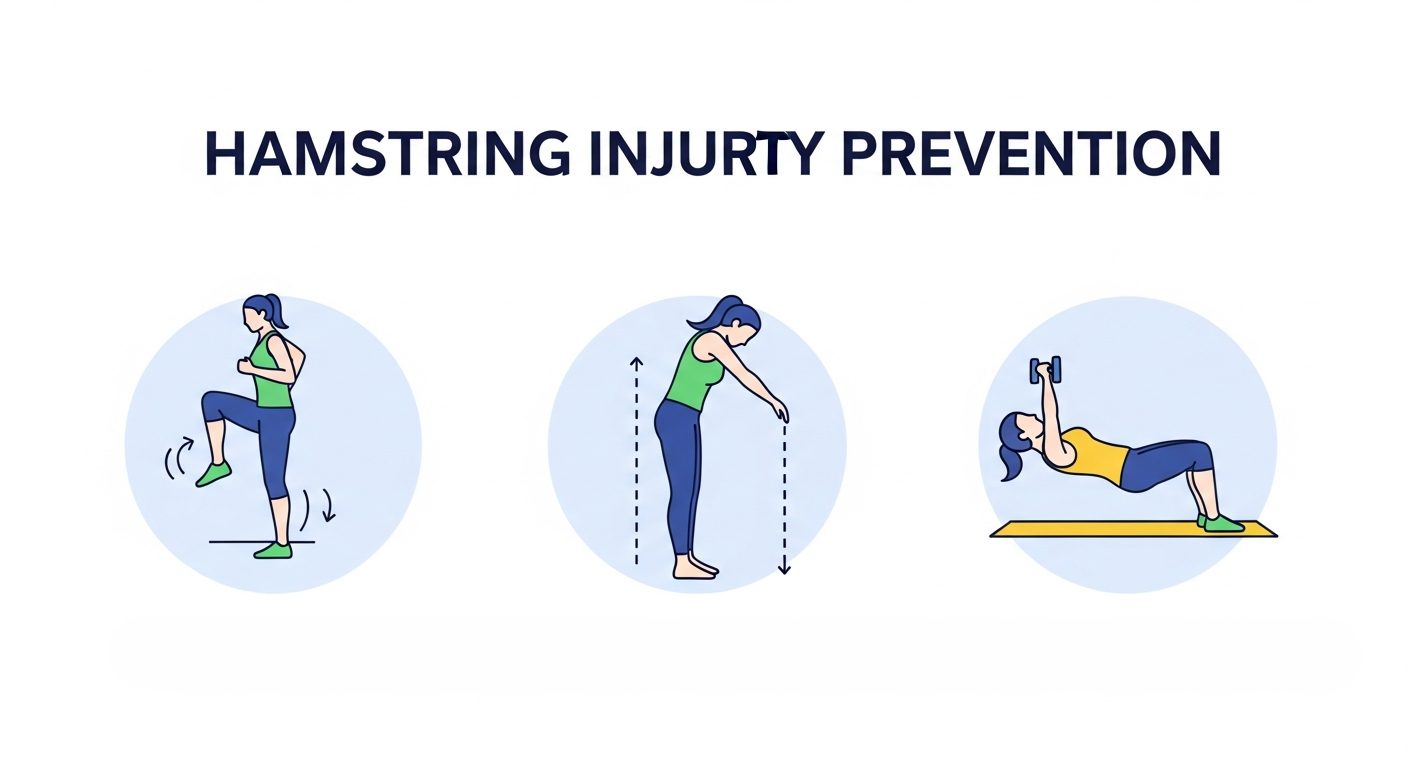
Dynamic stretching involves active movements that take your joints through their full range of motion. This is the ideal preparation before a run. Incorporate forward and lateral leg swings, walking lunges, high knees, and butt kicks to increase blood flow and muscle temperature.
Foam Rolling and Myofascial Release
Foam rolling helps release adhesions in the fascia surrounding the muscle tissue. Spend five to ten minutes rolling out your hamstrings, glutes, and calves before and after running. For deeper knots, use a lacrosse ball or massage gun to break up tight tissue clusters.
Phase 3: Strength Training
Building resilience within the muscle fibers is the most effective way to prevent tears. A strong muscle can absorb immense force without failing.
Eccentric Training
Because hamstrings typically tear during eccentric contractions, you must train them eccentrically. The Nordic hamstring curl is the gold standard for this. Additionally, perform Romanian Deadlifts (RDLs). Keep a slight bend in your knees and hinge at the hips, lowering a barbell or dumbbells while keeping your back perfectly flat. You will feel a deep stretch and contraction in the hamstrings as you lower the weight.
Concentric Training
Concentric exercises focus on shortening the muscle against resistance. Incorporate seated or lying leg curls using a machine or a resistance band. Glute bridges are also excellent; lie on your back with your knees bent and drive your hips toward the ceiling, actively squeezing your hamstrings and glutes at the top.
Compound Movements
Squats and traditional deadlifts build overall lower body power and improve coordination between the quads, glutes, and hamstrings. Emphasize strict form. A poorly executed deadlift will bypass the hamstrings and place dangerous stress on the lower back.
Glute Activation Exercises
Your glutes are the primary engines for hip extension. If your glutes are weak, your hamstrings are forced to take over the workload (a condition known as synergistic dominance). Perform clamshells, lateral band walks, and single-leg hip thrusts to ensure your glutes are firing correctly to support the hamstrings.
Phase 4: Core Stability and Pelvic Control
Your legs are only as strong as the core that supports them. Pelvic positioning directly dictates hamstring tension.
Importance of a Strong Core
A strong core prevents the pelvis from dumping forward during a run. By maintaining a neutral pelvis, you allow the hamstrings to operate from an optimal length, rather than starting from an overstretched position.
Plank Variations and Core Exercises
Incorporate standard planks, side planks, and the bird-dog exercise to build isometric core strength. Russian twists and medicine ball throws will develop the rotational stability required to counter the twisting forces generated by your arms and legs during running.
Pelvic Tilts and Hip Flexor Stretches
Tight hip flexors physically pull the pelvis forward. Counteract this by stretching your hip flexors daily in a kneeling lunge position. Practice posterior pelvic tilts by lying on your back and consciously flattening your lower spine against the floor by engaging your lower abdominals.
Phase 5: Sport-Specific Drills and Plyometrics
Once you have established flexibility, strength, and core control, you must train the hamstrings to handle high-speed, dynamic forces.
Gradual Return to Running and Sprinting
Never jump straight into maximum effort sprints. Use a progressive approach. Start with tempo runs at 70% of your maximum speed, gradually increasing the intensity over several weeks. Focus heavily on maintaining proper form, ensuring your foot strikes under your center of mass.
Agility Drills
Set up cones or an agility ladder on a grass field. Perform lateral shuffles, quick directional changes, and acceleration-deceleration drills. This trains the hamstrings to stabilize the knee and hip during chaotic, unpredictable movements.
Plyometric Exercises
Plyometrics teach the nervous system to recruit muscle fibers rapidly. Incorporate box jumps, broad jumps, and alternating bounding. Focus aggressively on landing mechanics. Absorb the impact softly by bending your knees and hips, allowing your muscles to act as shock absorbers.
Nutritional Considerations for Muscle Health
 Exercise breaks muscles down; nutrition builds them back up. A comprehensive injury prevention plan must account for what you put on your plate.
Protein Intake for Repair and Growth
Protein provides the amino acids necessary to repair the micro-tears caused by training. Ensure you consume a high-quality protein source—such as chicken, fish, eggs, beans, or whey protein—within an hour of finishing a strenuous workout to kickstart the muscle synthesis process.
Micronutrients
Specific vitamins and minerals regulate muscle contractions and prevent cramping. Magnesium and potassium are critical electrolytes that help muscles relax after contracting. Incorporate bananas, spinach, sweet potatoes, and avocados into your diet. Vitamin D plays a vital role in musculoskeletal health and calcium absorption, so prioritize moderate sun exposure or consider a high-quality supplement.
Hydration
Dehydrated muscle tissue is brittle and highly susceptible to cramping and tearing. Drink plenty of water throughout the day, not just during your workout. Monitor your urine color; it should be a pale, straw-like yellow. During intense, sweaty sessions, consume an electrolyte beverage to replace lost sodium and potassium.
The Importance of Proper Warm-up and Cool-down
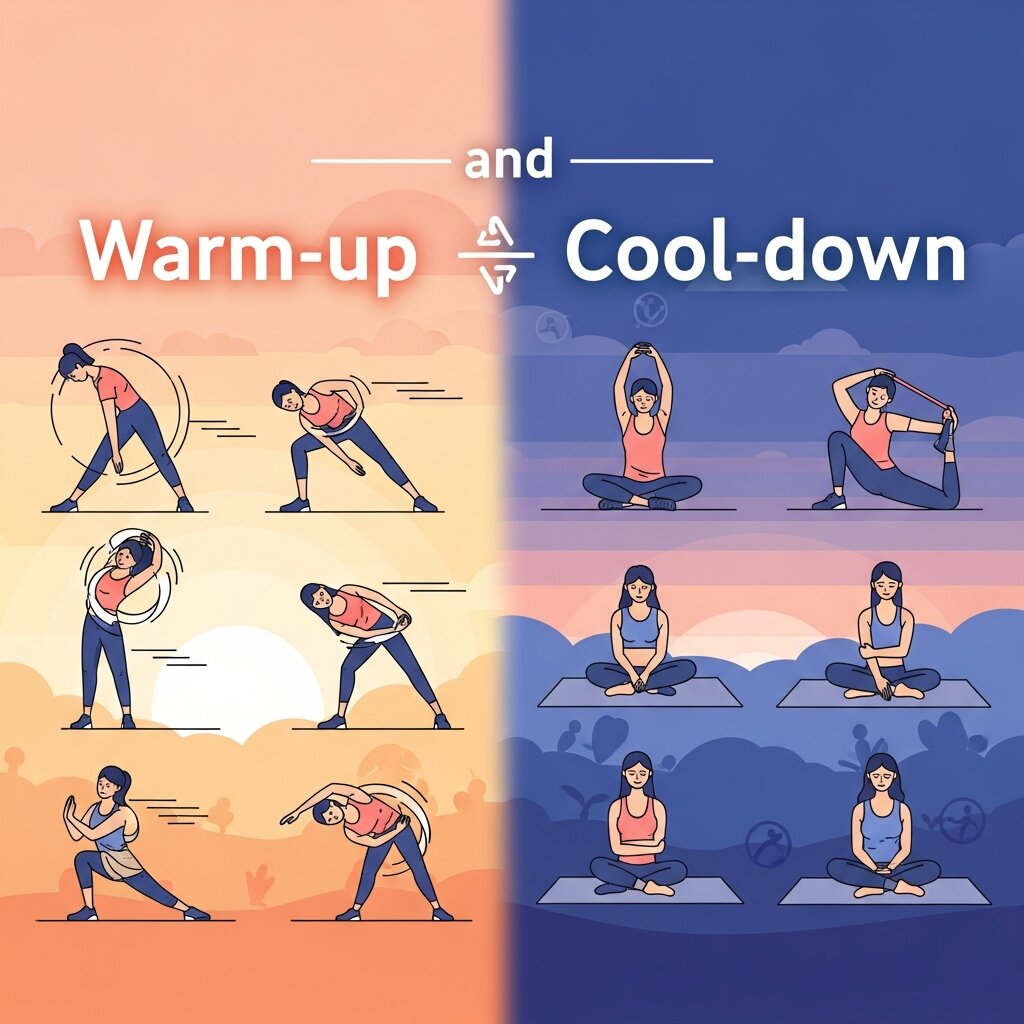 Skipping the warm-up or cool-down is a guaranteed fast track to an injury. These transitional periods prepare your body for stress and facilitate recovery.
Dynamic Warm-up Components
A proper warm-up should last at least ten to fifteen minutes. Start with light cardiovascular activity like a slow jog or jumping jacks to raise your core temperature. Transition into dynamic stretches like Frankenstein’s (straight leg kicks), walking lunges with a torso twist, and high knees. This lubricates the joints and primes the nervous system for the specific movements you are about to perform.
Static Cool-down Stretches
Once your workout is complete and your muscles are warm and pliable, transition into static stretching. Focus on holding deep, comfortable stretches for the hamstrings, calves, quads, and hips. This helps flush out metabolic waste products and gently elongates the muscle fibers to prevent them from locking up as they cool down.
Recognizing and Responding to Early Warning Signs
Listening to your body is a non-negotiable skill for runners. Ignoring warning signs leads to severe structural damage.
Muscle Soreness vs. Pain
Delayed Onset Muscle Soreness (DOMS) is a normal, dull, aching sensation that peaks 24 to 48 hours after a tough workout. It is symmetrical and fades with light movement. Pain, on the other hand, is sharp, localized, and sudden. If you feel a distinct twinge, stabbing sensation, or sudden weakness in one specific hamstring, stop running immediately.
When to Rest and Seek Professional Help
If you suspect a hamstring strain, immediately implement the RICE protocol: Rest, Ice, Compression, and Elevation. Avoid stretching the injured muscle, as this can worsen the tear. If the pain persists for more than a few days, causes a noticeable limp, or is accompanied by bruising, seek professional help from a physical therapist or sports medicine physician. They can provide a structured rehabilitation plan involving ultrasound therapy, deep tissue massage, and targeted exercises to safely guide you back to running.
Keep Your Stride Strong and Injury-Free
 Implementing a rigorous hamstring injury prevention program requires patience, consistency, and a willingness to look beyond simply logging miles. By dedicating time to strengthening your posterior chain, improving your mobility, and addressing biomechanical imbalances, you can drastically reduce your risk of suffering a debilitating strain.
The long-term benefits of a proactive approach to injury prevention are undeniable. You will enjoy more consistent training blocks, set new personal records, and experience the simple joy of running without the constant fear of pain. Treat your hamstrings with the respect they deserve, fuel your body properly, and commit to the necessary strength work. Keep your stride strong, stay healthy, and enjoy the miles ahead.